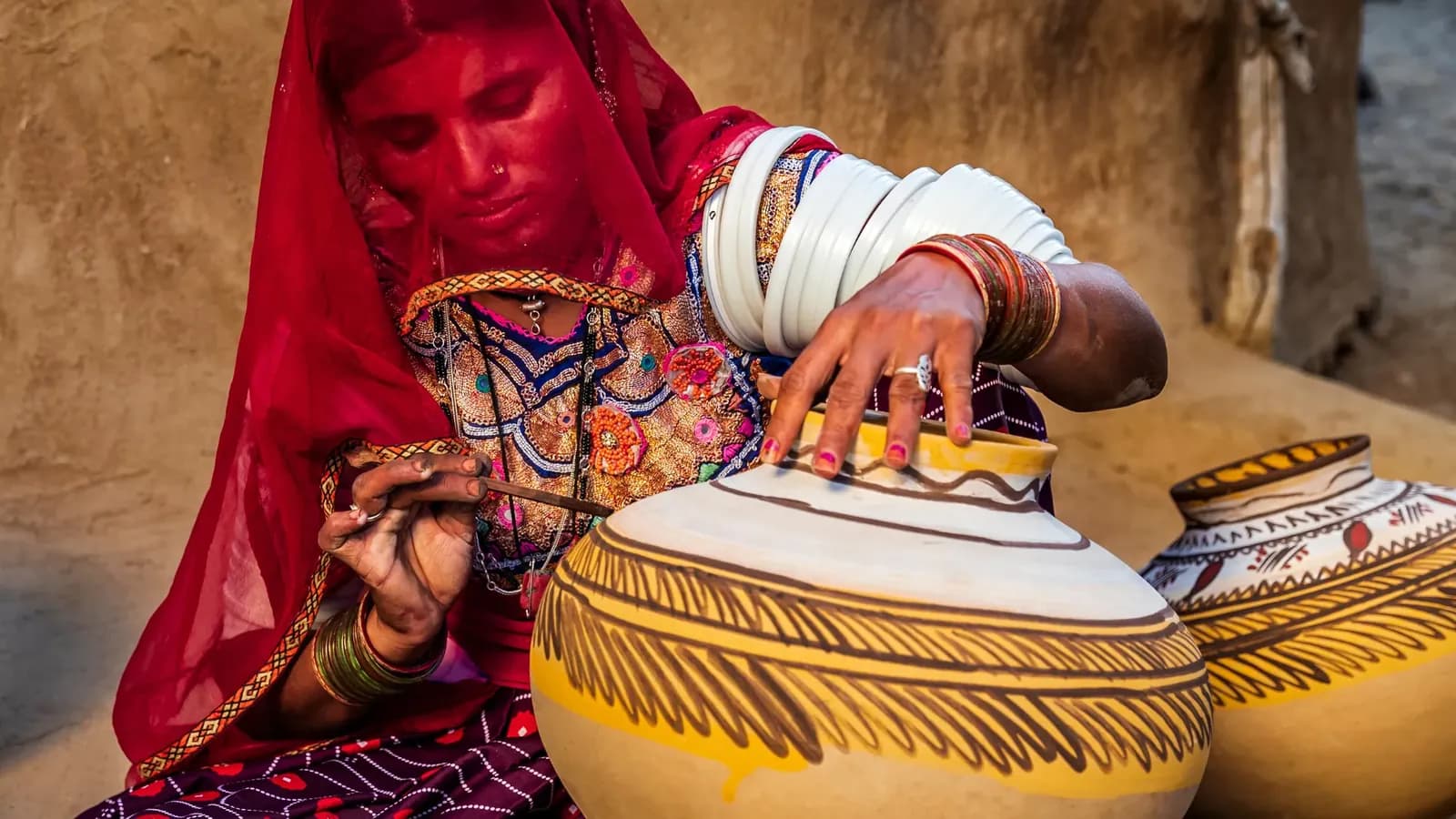
Somewhere in the old city right now, a painter is bent over a desk the size of a chessboard, adding eyelashes to an elephant with a brush that has just a few hairs on it. That patience is what Mewar miniature painting is built on.
This guide is for travellers who want more than a pretty picture to frame. Here's what to look for, where to see good work, how to try it yourself and how to make sure the piece you take home was actually painted by hand.
What makes Mewar painting different
Mewar is one of the oldest schools of Rajasthani painting, and it grew up around the royal court of the Sisodia rulers. Its golden age came in the 17th century, when court artists illustrated great series of the Ramayana, the Bhagavata Purana and Ragamala, paintings that turn musical modes into scenes.
You'll recognise the style once you know the signs:
- Bold, flat colour. Deep reds, saffron yellows and rich greens, often with a single strong background colour.
- Stylised faces. Profiles with long, almond-shaped eyes and sharp noses.
- Stories in layers. One painting may show several moments of a tale at once, divided by hills, walls or rivers.
- Court and devotion. Maharanas at durbar, hunting parties, festival processions and Krishna among the cowherds.
Later, painters in Udaipur also recorded royal life in large, busy compositions of the city, its lakes and its festivals. If you've stood on a ghat at dusk, you'll recognise the scenes.
Where to see good miniatures in Udaipur
The City Palace
The City Palace museum, run by the Maharana of Mewar Charitable Foundation, displays royal paintings alongside the rooms they were made for. Seeing a court scene and then walking into a similar courtyard is the best introduction you can get. Allow two to three hours for the palace and check current timings at the counter.
Painters' studios in the old city
The lanes around Jagdish Temple, Lal Ghat and Hathi Pol are full of small studios where artists work in the front room. Most are happy for you to watch, and the good ones will happily talk you through their brushes and colours. Our markets guide maps out these streets.
Shilpgram
During the December Shilpgram Utsav, painters from across the region set up stalls, and you can compare Mewar work with other Rajasthani styles in one afternoon.
How a miniature is made
Traditional painters work on thick handmade paper, sometimes layered and polished smooth, or on silk. Colours come from mineral and plant pigments ground by hand and mixed with gum, and real gold and silver are used for highlights. The finest brushes are traditionally made from squirrel hair, which is how you get lines thinner than a thread. Between layers, the painting is burnished with a smooth stone so the colour sits flat and glows.
A detailed piece can take days or weeks. That's worth remembering when you see two similar-looking paintings at very different prices.
Learn it: taking a class
Many studios in the old city offer short lessons, from a couple of hours to several days. In a beginner session you'll usually trace a simple motif (an elephant, a peacock, a lotus), learn how to hold the fine brush and fill in flat colour. Nobody expects a masterpiece. The point is to understand how hard this is, and you will.
Local tip: Ask to book your class for the morning. The light in the old city is soft and even, your hand is steadier before lunch, and you'll have the afternoon free for the lakes.
Buy it right: hand-painted or printed?
The old city sells both, and they can look alike from a metre away. Get closer.
- Use your phone camera. Zoom in. A print shows a grid of tiny dots; a painting shows brushstrokes and slight variations in colour.
- Look at the edges. Hand-painted borders have small irregularities. Perfectly crisp, identical borders on many paintings are a warning sign.
- Tilt it. Real gold catches the light and may sit slightly raised. Printed gold looks flat.
- Check the back. Handmade paper has texture and uneven edges.
- Ask about ivory. If anyone claims a miniature is painted on ivory, walk away. It's either fake or illegal. Painted bone, silk and paper are the honest options.
Ask who painted it and how long it took. A real artist will answer with detail and pride. If you're buying several crafts, our souvenir guide has bargaining tips that apply here too.
Good to know: Paintings on paper travel best flat, between two sheets of card. Most studios will pack them for you, so just ask.
To dig deeper into the stories behind these paintings, explore Udaipur's culture and history.
Quick answers
What is Mewar miniature painting?
A school of Rajasthani painting that developed at the court of Mewar, known for bold colour, stylised figures and scenes from epics, Krishna stories and royal life.
Can I learn miniature painting in Udaipur?
Yes. Many old-city studios offer short beginner classes; ask around Jagdish Temple and Hathi Pol and agree the length and cost upfront.
How do I know if a miniature painting is real?
Zoom in with your phone. Brushstrokes and colour variation mean hand-painted; a regular dot pattern means it's a print.